


Among my books, I have an orthodox Jewish prayer book. Toward the end of the bedtime prayer, the text asks God to protect and guard our souls through His holy watchers, the angels, who walk through the night. It goes on to call "Michael to my right side, Gabriel to my left, Uriel before me, and Raphael to my back."
 Of these four, it is Gabriel who appears most often in the Hebrew bible and biblical commentary. He
is first mentioned by name in the Book of Daniel. After Daniel experiences a vision, Gabriel comes to him and tells him what it means (8:16).
Of these four, it is Gabriel who appears most often in the Hebrew bible and biblical commentary. He
is first mentioned by name in the Book of Daniel. After Daniel experiences a vision, Gabriel comes to him and tells him what it means (8:16). A year later, Gabriel appears again telling Daniel that He has "been at war, and going to fight those who remain" (9:27). No further details of this war are given and Gabriel's name is not mentioned again in the Hebrew bible. But he is referenced repeatedly in the rabbinical literature as a warrior and a holy protector.
In the Book of Enoch, Gabriel is an avenging angel, sent to provoke sinners to war. In the Talmud, God sends him to smite the Assyrians, and Gabriel answers God by saying that him sword "has been sharpened since the six days of Creation." Which is to say that he was born to fight.
Consistent with this declaration, most traditional Jewish sources describe Gabriel as the emissary of God's power. And the Hebrew name Gavriel, or Gavar El, means "God's might." He is represented by the element of fire in some Talmudic references and in others by water. In all instances, he is among the strongest of the seven archangels and a force to be reckoned with.

This weekend's flea market angel was different. His wings were battered and his garments were faded but his face was beautiful and strong and really, surprisingly, just as I imagined it. I count his unexpected appearance a message and a reminder: Angels are emissaries and we are never really alone.

 |
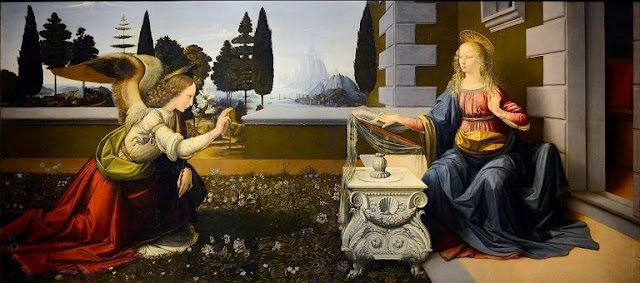
| Love the soft colors in this image. |
 |
| The Annunciation by Leonardo Da Vinci |
And I heard a man’s voice between the banks of the U′lai, and it called, “Gabriel, make this man understand the vision.” So he came near where I stood; and when he came, I was frightened and fell upon my face. But he said to me, “Understand, O son of man, that the vision is for the time of the end.” - Daniel 8:16-17 RSV-CE
Nowhere, however, is St. Gabriel's role as a messenger more important than when he addresses the Blessed mother in Luke 1:26-38:
In the sixth month the angel Gabriel was sent from God to a city of Galilee named Nazareth, to a virgin betrothed to a man whose name was Joseph, of the house of David; and the virgin’s name was Mary. And he came to her and said, “Hail, full of grace, the Lord is with you!” But she was greatly troubled at the saying, and considered in her mind what sort of greeting this might be. And the angel said to her, “Do not be afraid, Mary, for you have found favor with God. And behold, you will conceive in your womb and bear a son, and you shall call his name Jesus.He will be great, and will be called the Son of the Most High; and the Lord God will give to him the throne of his father David, and he will reign over the house of Jacob for ever; and of his kingdom there will be no end.”...And Mary said, “Behold, I am the handmaid of the Lord; let it be to me according to your word.” And the angel departed from her.-Luke 1:26-33, 38 - Revised Standard Version - Catholic Edition

About This Image

The image above is a colorized version of "Saint Michael" by Italian master Guido Reni (1575–1642). This image is featured on the St. Michael printable prayer card available in my Etsy shop, Catholic Book And Card. For the card, I tinted the original paint to the vivid blue associated with Saint Michael (as shown above).
Saint Michael in the Bible
Saint Michael, is one of three archangels the Bible mentions by name (the others being Saints Raphael and Gabriel). Saint Michael is mentioned four times - twice in the Old Testament, and two more times in the new.
The first reference is in the Book of Daniel. In Chapter 10 St. Michael comes to comfort Daniel after he has had a vision, and promises to be his helper in all things. In Daniel 12, St. Michael is called "the great prince who standeth for the children of Thy people."
In these references St. Michael is shown to support Israel during the seventy years of the Babylonian captivity. In writing about St. Michael Daniel, strove to show his people that God had not forgotten them, and remind them that even in bondage they had a royal champion. In St. Jude 9, we are told that Michael disputed with the devil over the body of Moses - an episode not mentioned elsewhere in the Bible.
In the Revelation (Chapter 12) we find the most dramatic reference to St. Michael. Here St. John recounts the great battle in Heaven, when the wicked angels under Lucifer revolt against God. In this passage, Michael, leading the faithful angels, defeats the hosts of evil and drives them out.
Because of this victory, St. Michael is revered in Catholic tradition and liturgy as the protector of the Church.
Michael's battle against the rebel angels has been painted by many artists (one such painting serves as the main banner of this blog). It has been written about various writers, as well, including the poet Milton in book 6 of Paradise.
In the Eastern Church, St. Michael is placed over all the angels, as prince of the Seraphim. And, in Asia Minor, many curative springs were dedicated to him.
St. Michael is a powerful figure in spiritual warfare. He is considered to be the special patron of the sick, police officers, the military, the state of Israel and the Catholic Church. St. Michael's emblems are a banner, a sword, a dragon, and scales.
St. Michael's name is a variation of Micah, which asks (in Hebrew), "Who is like God?" It is the same question posed by Moses in Exodus 15:1-11. The passage, also called the Song of the Sea, is thought to be a very old section of Scripture that can still be heard today in the Mi Kamocha of Jewish worship:
Who is like You among the gods, Adonai? Who is like you? Glorious in holiness, awesome in praises...
About Michaelmas
Today September 29th is St. Michael’s feast day. During the middle ages this day - known as Michaelmas - was a holy day of obligation.
In 1969, the Novus Ordo Calendar added combined the feasts of St. Gabriel and St. Raphael with St. Michael's and discontinued the individual feasts of the archangels. Traditional Latin Mass congregations using the pre 1962 liturgical calendar keep the original dates for all three feasts. So, for me, this is St. Michael's day alone.
The SSPX (Society of St. Pius the X) devotional newsletter suggests that today is a good day to read the proper of the Mass of St. Michael, as found in the traditional missal. The newsletter also encourages us to "pray to St. Michael when temptations arise, especially those related to abuses of the internet, radio, and telephone."
The St. Michael Prayer
The Saint Michael Prayer is an amazing prayer for spiritual warfare. The abridged version (below) is short and easy to memorize and it can be said anytime you are feeling in need of spiritual protection. The prayer was written in Oct. 1, 1884 by Pope Leo XIII following a disturbing mystical experience at Mass.
The Pope had just finished celebrating Mass when he suddenly stood transfixed in front of the altar as if in a trance, his face drained of color. Once recovered, he went to his office and composed a prayer to St. Michael. He told his staff the prayer should be offered throughout the Church.
Pope Leo told others that he had heard two voices which he believed to voices of Our Lord and of Satan. The Pope heard Satan boast that he could destroy the Church in 75 or 100 years, if given the opportunity. Then he heard Our Lord give Satan permission to make the attempt.
The prayer was recited after Low Mass in the Catholic Church from 1886 until it was discontinued in 1964. Thirty years later, in his Regina Coeli address, Pope John Paul II said, “Although the prayer is no longer recited at the end of Mass, I ask every one not to forget it and to recite it to obtain help in the battle against the forces of darkness and against the spirit of the world.”
I'm happy to say that, at the SSPX Chapel I attend, the priest leads the faithful in the prayer to St. Michael after each and every Mass!
Saint Michael the Archangel, defend us in battle. Be our protection against the wickedness and snares of the devil. May God rebuke him, we humbly pray; and do Thou, O Prince of the Heavenly Host - by the power of God - cast into hell, Satan and all the evil spirits, who roam about the world seeking the ruin of souls. Amen.

To purchase the St. Michael printable prayer card (75¢ US) please check out my Etsy listing here.
_______

Please join me on Blog Talk Radio this Thursday night at 11 PM EST at to meet my very special guest, author, webmaster, spiritual teacher and Near Death Experiencer Diane Goble.

 |
| Full Haul (minus one voucher gift :) |
 |
| Angel Detail. Can't wait to find her a home in my new place! |
 |
| Close Up of Cards. Enlarge to see gorgeous Van Gogh sky backgrounds! |


If you view this video full screen you will get a glimpse (at 0:48 on counter) of the archangel Michael / King of Swords card from this non-existent made for HBO Tarot deck. Too bad this deck cannot be bought. Still, what a really cool intro for the show and a wonderful concept for this card!

 |
| Photo by Birmingham Museums Trust on Unsplash |
Angels, according to Rabbi David Cooper in his book "Invoking Angels", are intermediaries of God. The Hebrew word for angel is מלאך (mal'ach) meaning messenger and while there are many different types of angels all angels function as intermediaries of God. According to Jewish thought, angels are wholly spiritual in nature, not the kindly humanoids of popular imagination.
Angels are considered infinite in number, filling heaven and earth, but ordinarily invisible, manifesting themselves to humans only on occasion. The body of Jewish literature called the Talmud teaches us that every individual has a guardian angel. This angel speaks to our soul as we are sleeping and carries messages both to and from God. I personally believe that angels do visit us in and out of dreams.
Rabbi Cooper's book


Translate
Social Icons